03.1. PROGAMME PROCESS: CLASSIC OPTION
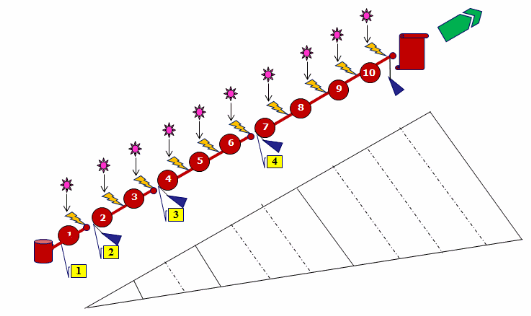
DIAGRAM
GLOSSARY

1. Introduction
Master of PersonalChampionship® is a self-concept re-engineering and behaviour modification system for developing complete, fully functioning, champion people for the personal and leadership challenges of our time and beyond. The following exposition explains the Classic process to achieve this goal..
2. Participants
Master of PersonalChampionship® participants –
1. Are committed to increasingly realizing their potential in all life spheres important to them.
2. Support the principles associated with scientific reasoning exemplified by creative conversation and methodological problem solving.
3. Agree to uphold Master of PersonalChampionship® business conditions;
4. Concur with the programme methodology as explicated on this website.
3. Exploration session
Master of PersonalChampionship® offers people interested in joining the programme an assessment of their current performance over the behaviour constructs: relatedness, autonomy, competency and goal navigation.
Following the assessment, prospective participants individually attends a consultation session during which the assessment results are discussed, and the degree to which the person could benefit from attending the programme is considered.
4. Programme phases
4.1. Description
The Master of PersonalChampionship® programme runs over four phases. With each following phase an added workshop expands its repertoire (see diagram above.)
Participants’ performance over programme phases is assessed by the criterion discussed under the following heading.
4.2. Performance criterion
A participant’s performance over programme phases is measured according to following criterion:
1. Satisfactory completion of workshop assignment prior to workshop attendance,
2. Full attendance of workshop presentations,
3. Adequate workshop participation so as to benefit group explorations,
4. Acceptable completion of post-workshop practice exercises,
5. Attendance of and participation in the consultation
session as indicated in the diagram presented above,
6. Timeous submission of progress reports.
5. Before workshop assignments
Prior to attending a workshop participants do the required preparation and submit to the programme coach a copy of their completed assignment. As a result, the programme coach is prepared for the upcoming workshop, consequently workshops are opportunities for discussion, learning and self-development.
6. Workshops
Workshop membership is limited to provide time for the programme coach to attend to participants’ questions, comments and needs; and for participants to feel comfortable to express their opinions.
A workshop is a one day experience and addresses a factor-set.
7. After-workshop practicum
7.1. operation
The duration of an after-workshop practice is two weeks during which time participants –
1. Apply the workshop principles to real-life situations,
2. Monitor their performance over time,
3. Keep score of their achievements,
4. Analyse their data, and
5. Produce a visual accomplishment representation.
7.2. PROGRESS FEEDBACK
Participants, during the practice period –
1. Give feedback to their programme coach on the progress they have made,
2. Comment on the problems they have encountered, if any,
3. Receive feedback from their coach on their progress reports.
Over the practice periods participants are free to contact their coach for advice and guidance.
8. Consultations
Participant attends a private consultation session with their coach at the start of the second, third and fourth programme phase, and finally at the end of the fourth phase (see diagram above.)
The consultation sessions –
1. Grant the coach the opportunity to become personally acquainted with participant’s growth experience and his or her expectations pertaining to the next programme grade;
2. Provide participant an opportunity to discuss personal matters that he or she rather not disclose during a workshop.
For the consultation procedure, see menu-item Consultations.
9. Self-report
Participants are cooperatives in their progress measurement.
They –
1. Exploit their GrowthTargetList to identify core self-improvement objectives;
2. Complete a GrowthPlanner for each growth target they select;
3. Record their progress with the aid of their GrowthRecorder;
4. Table their results and then chart their progress to construct a visual image;
5. Interpret their findings;
6. Compile a report.
10. Achievement recognition
Participants who have successfully completed the Master of PersonalChampionship® is offered Fellowship of the Champion People Society™.
11. Champion people society™
11.1. Fellowship
Participants who have achieved the Master of PersonalChampionship® award are offered fellowship of the Champion People Society™
11.2. ONLINE
Fellows of the Champion People Society™ –
Receive online the latest personal development information as it becomes available;
Have access to expert counsellors when life bowls them curve-balls.
11.3. CONFERENCES
In order to reap the benefits of global discourse and social get-together we arrange annual conferences.
11.4. EXPONENTS
Our paramount goal is a world governed, lived and enjoyed by complete, fully functioning, champion people for our times and for generations to come. Towards that end we are its exponents.